

Key takeaways:
- Every new 3CX client adds linear management overhead — more systems, more logins, more manual checks
- Hiring doesn’t fix the model, it delays the next bottleneck
- Centralized monitoring replaces dashboard hopping with one screen
- Policy-based configuration makes the 50th system as fast to onboard as the 5th
- The savings compound: onboarding, drift detection, monitoring, and billing all scale flat
The Scaling Problem Every 3CX Reseller Hits
At some point, every growing 3CX reseller runs into the same wall: every new client means another system to configure, monitor, and maintain. The work grows linearly with your client base. What felt manageable at 10 systems starts breaking at 30, 40, 50.
The obvious answer is more staff. But hiring is expensive, takes time, and doesn’t actually fix the underlying problem — it just delays the next wall.
The real problem isn’t headcount. It’s that the management model doesn’t scale.
Why One-System-at-a-Time Management Hits a Ceiling
3CX was designed for managing a single system. The admin console is excellent for one system. It was never built for managing dozens or hundreds of them.
So every system you manage is its own island:
- Its own dashboard you log into separately
- Its own configuration you maintain manually
- Its own backup status you check independently
- Its own settings that can drift from your standard without anyone noticing
The time you spend isn’t on hard problems. It’s on the same routine checks repeated across every system. Login, check status, check backups, verify settings, move on to the next one. Multiply that by your system count and the math gets ugly fast.
Breaking the One-to-One Model
Scaling without adding headcount requires changing the equation: managing systems as a portfolio instead of individually. That’s the core of Controvo’s approach as an RMM purpose-built for 3CX.
Centralized Monitoring
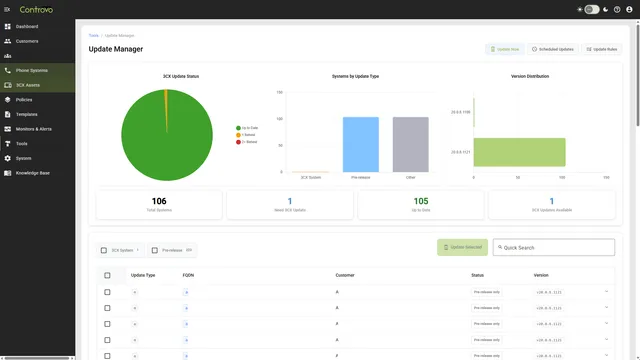
Instead of logging into each system, see all of them from one dashboard. System health, extension counts, backup status, license expirations. Visible in one place. Routine status checks that took an hour across 40 systems take minutes. See how data-driven monitoring works →
Policy-Based Configuration
Instead of manually configuring each system to your standard, define the standard once as a policy and apply it. New system? Assign the policy, click apply, done in two minutes. No process docs. No variability between technicians.
Automatic Drift Enforcement
Instead of hoping settings stay the way you configured them, let the system watch for you. When something drifts from your standard — a quick fix that bypassed your process, a client request handled ad-hoc — you get notified, or the system fixes it automatically. Your choice, down to the individual setting.
Agentless Architecture
Instead of installing and maintaining monitoring agents on every system, connect through 3CX’s own APIs. See the full platform capabilities. Nothing to deploy on client systems, nothing to update, nothing to troubleshoot when an agent goes sideways.
What This Actually Looks Like
Imagine you’re onboarding a new client. Today, your technician follows a process doc (hopefully), configures every setting manually, and you trust that nothing was missed.
With policy-based management, you assign your standard policy to the new system and apply it. Every setting matches your standard in minutes. If anything changes later, the system catches it.
Now imagine you’re taking over a client from another provider. Today, you’d need to audit every setting manually to bring the system into your standard. With a policy engine, you assign your policy and instantly see every setting that doesn’t match — before changing anything. Maybe call recording is off on the owner’s extension for a reason. Now you know to pick up the phone and ask before you flip it on. The preview gives you the conversation, not just the fix.
That’s how you go from managing systems to managing a portfolio.
The Compounding Effect
The real payoff isn’t just time saved on individual tasks. It’s what happens as you grow:
- New system onboarding goes from hours to minutes
- Configuration drift gets caught automatically instead of discovered after a client complaint
- Routine monitoring becomes a glance at one dashboard instead of a tour through dozens
- Client reviews and billing pull from centralized data instead of manual compilation
Each of these savings is modest on its own. Across a growing portfolio, they compound. The 50th system you add takes the same effort as the 5th — which is the only way to grow without proportionally growing your team.
Ready to break the one-to-one model? Apply for the pilot program. 20 spots, free during the pilot. Or ask us anything.